
Studying in Belgium · Italy
Studying in Belgium as an Italian citizen.
Italians are the second European nationality at the six universities of the Fédération Wallonie-Bruxelles behind the French, with 1,665 students according to table 1.3.1 of the directory of the Conseil des rectrices et recteurs (CRef), the latest published breakdown (2021-2022); the hautes écoles are not included. So there is no visa to apply for, but there is an equivalence file in which a single badly chosen school document is enough to block a start of the academic year.
Updated on September 8, 2026
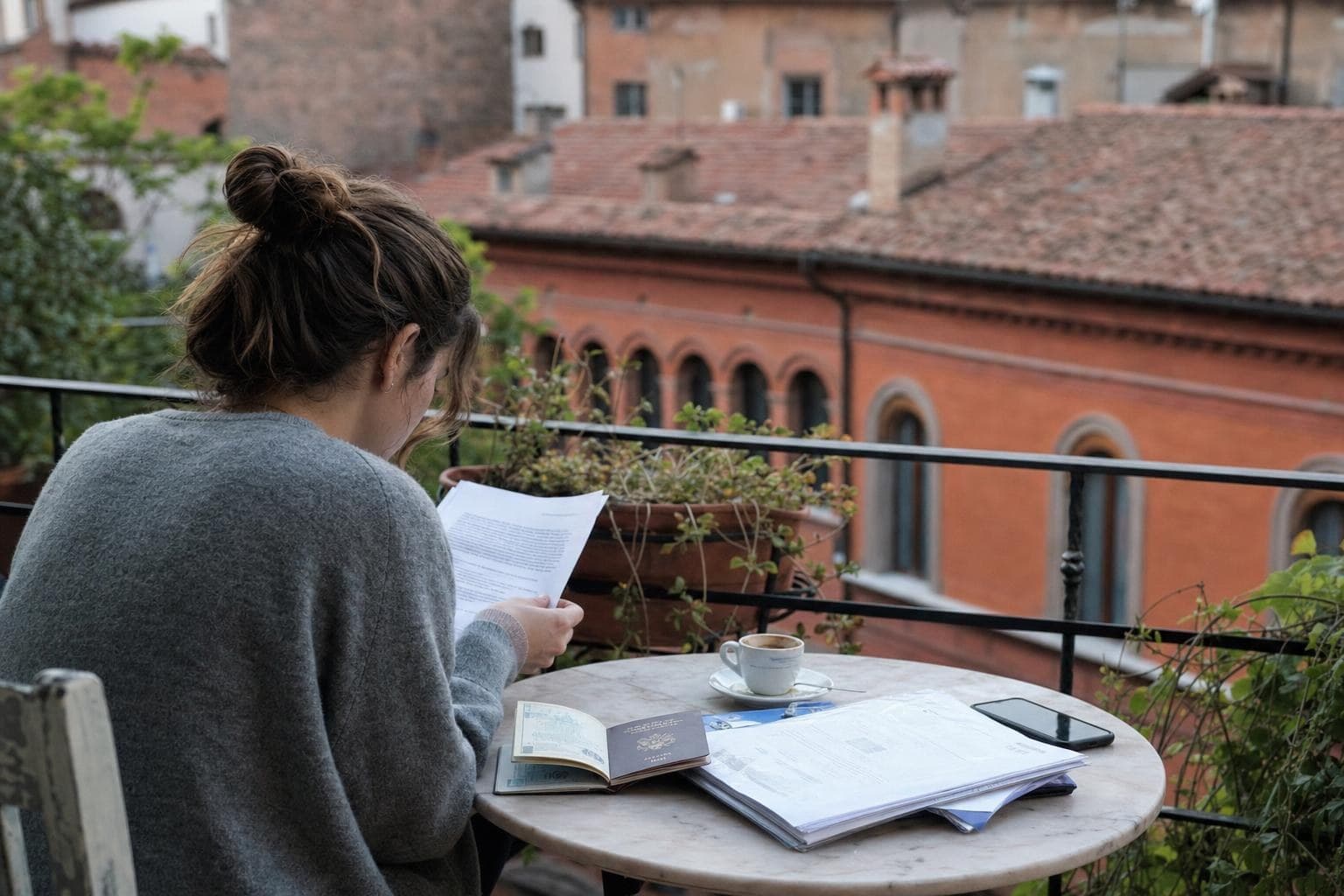
In short
An Italian student needs no visa to study in Belgium: as a citizen of the European Union, they declare their presence to the commune and then request the registration certificate (annexe 19) no later than three months after entering the country, failing which a fine of EUR 200 applies. Their secondary school leaving diploma, on the other hand, must be the subject of an equivalence with the Equivalence Service of the Fédération Wallonie-Bruxelles (EUR 400, non-refundable, four to twelve weeks of processing): the Service asks for the diploma of the Esame di Stato and the transcript of the State examination, Allegato del diploma or Curriculum dello studente, and explicitly refuses the Pagella scolastica. Thanks to the Brussels Convention of 25 May 1987, Italian documents need no apostille: a copy certified true by a municipal administration, in Italy or in Belgium, is enough, and Italian is exempt from translation. The minerval stands at the full rate of EUR 1,194 for 2026-2027, with no supplementary fee, but a student arriving from Italy is a non-resident: for quota-limited programmes, they remain subject to the quota and to the electronic filing in the last days of August, lodged with the institution concerned.
Does an Italian student need a visa for Belgium?
No. Free movement exempts citizens of the European Union from any study visa for Belgium. The formalities are municipal: a declaration of presence within ten working days when you are not yet staying at a registered address, then the request for a registration certificate (annexe 19) from the municipal administration of your place of residence, no later than the expiry of the three months following entry into Belgium. Beyond that deadline, the administrative fine is EUR 200.
For student status, the commune asks for an enrolment in an organised, recognised or subsidised institution, health cover (the European Health Insurance Card is accepted, as are private insurance, an S1 form or membership of a Belgian health insurance fund), proof of sufficient resources and proof of citizenship. The Immigration Office then has six months to decide; the student receives an annexe 8ter and then an EU citizen residence card. In Brussels, the procedure takes about three weeks and costs EUR 25 and then EUR 30.
Since 1 September 2025, the file must be complete from the very first visit to the commune: one missing document and the application is not taken into consideration, you have to start again. We prepare the exact list of documents your commune expects before you go to the counter.
Does the Italian diploma have to be the subject of an equivalence?
Yes, and it is an individual application. No national diploma of the European Union is recognised as of right in the Fédération Wallonie-Bruxelles: only the European baccalaureate, the baccalaureate issued by the International Baccalaureate Office, the SHAPE CESS and schools following a Belgian curriculum abroad are exempt. The former ministerial order of 15 March 1967, which determined the university examinations open to holders of Italian secondary diplomas, was repealed by the Government order of 17 May 1999: since then, every Italian diploma goes through the Equivalence Service.
The Service publishes an "Italy" sheet which asks for two school documents: the secondary school leaving diploma, the one issued by the Esame di Stato at the end of the liceo, istituto tecnico or istituto professionale track, and the transcript of the State examination, that is, the Allegato del diploma or the Curriculum dello studente, as a certified true copy. The fees are EUR 400, non-refundable; the reference of the transfer must read "équivalence de" followed by the applicant's surname and first name, and the proof of payment enclosed must be an original document attesting the debit. Filing opens around mid-November and closes on 15 July preceding the start of the academic year (from 15 November 2025 to 15 July 2026 for the year 2026-2027; the 2027-2028 dates are to be confirmed on equivalences.cfwb.be), for an announced processing time of four to twelve weeks minimum. As Italian is among the exempted languages, no translation is to be expected.
The Pagella scolastica is not accepted: the Italy sheet says so in black and white. It is the document families send most spontaneously, because it is the one the school hands over first. The right transcript is the Allegato del diploma or the Curriculum dello studente, the one that carries the results of the State examination.
Italy is among the countries that have ratified the Brussels Convention of 25 May 1987, which circular 8171 of the Equivalence Service names expressly: its school documents escape the apostille. The certified true copy is obtained from the municipal administration of the place of residence, in Italy or in Belgium, or directly from the Equivalence Service on production of the originals. On the other hand, the Service's "certified true copies of documents" sheet refuses copies certified by the police, by the school, by a notary, by the post office, by a court or by the Embassy of Belgium: a copy made at the wrong counter is a copy to be made again.
For those graduating in June 2026, the Service issues a provisional equivalence on the basis of the transcript of the State examination. It is valid until 15 May 2027: the certified true copy of the final diploma must be produced before that date to obtain the definitive equivalence, which then carries no expiry date. The Service does not publish a standard decision by country: the decision states the access it opens, and an equivalence may carry restrictions, which can be lifted by the DAES, the secondary school examination board of the Fédération Wallonie-Bruxelles; that situation concerns first and foremost files from outside the European Union. If your studies were strongly oriented towards professional practice, the Service recommends coming to present the file before lodging it.
Do you have to prove your level of French?
No decree imposes a level of French for entry into a bachelor's degree. Article 108 of the décret paysage only covered three teacher training bachelor's degrees (agrégé de l'enseignement secondaire inférieur, primary school teacher, pre-school teacher) and its effects were limited to the academic years 2019-2020 to 2022-2023. For those programmes, the expected level was B2 of the European framework, with proof such as the DALF, DELF B2, TEF level 4 or TCF B2, or an examination organised at least twice a year by the institutions according to the arrangements set by ARES.
That said, each university remains free to ask for proof of French, often at B2 level, when the diploma was not obtained in French: that is the case of an Italian diploma. The ULB does not require it at bachelor's level, other institutions include it in their admission file. The rule is therefore not a general one, it is specific to the institution and the programme you are aiming at: it is a point to check before applying, not an obstacle to assume.
Is an Italian student subject to the non-resident quota?
Yes, if they do not have their main residence in Belgium. The decree of 16 June 2006 classes such a student among non-residents and limits their number in the so-called quota-limited programmes. That is the real friction point for a candidate arriving from Italy, far more than residence or the minerval: selection does not turn on the school record, but on a three-day window and a draw supervised by a sworn bailiff.
| Quota-limited programme | Selection of non-residents for 2026-2027 |
|---|---|
| Medicine, dental sciences | Entrance exam on 27 August 2026, quota of 15% of the eligible candidates, registration from 18 May to 5 July 2026 |
| Veterinary medicine | Application to be filed online with the institution on 25, 26 and 27 August 2026, draw, quota of 20% |
| Physiotherapy and rehabilitation, speech therapy, audiology, psychological sciences speech therapy orientation | Application to be filed online with the institution on 25, 26 and 27 August 2026, draw, quota of 30% |
| Results of the draw | published by each institution, on 7 September 2026 at ULiège and at the ULB; only one quota-limited application allowed per student, in a single institution |
Places are counted: for 2026-2027, ULiège announced 42 non-resident places in veterinary medicine for 219 applications, 76 in physiotherapy for 196 applications and 12 in speech therapy for 36 applications; the ULB, 25 places in veterinary medicine for 97 applications and 64 in physiotherapy for 184 applications. These figures cover all non-residents, whatever their nationality: ARES does not publish a breakdown by country.
Two different procedures, often confused, and falling almost on the same day: the filing for the programmes selected by draw takes place on 25, 26 and 27 August 2026, with the institution, without prior registration; the entrance exam for medicine and dentistry is held on 27 August 2026, but you must have registered between 18 May and 5 July 2026 on concoursmd.be. Missing the spring window closes the door to medicine, whatever happens at the end of August. You may lodge only one application, in a single quota-limited programme and in a single institution: a second application filed in parallel counts as a duplicate and eliminates you.
Resident status, which takes you out of the quota, is acquired after five years of uninterrupted residence in Belgium, proven by an E+ or EU+ permanent residence card and a residence certificate with history. An Italian student who has already lived in Belgium since childhood is therefore not concerned by the quota: the first thing to establish is which side of that line you are on.
How much does a year of study cost for an Italian student?
The registration fee is that of European students: EUR 1,194 for 2026-2027, an amount set by the programme decree of 5 June 2026 published in the Moniteur belge of 24 June 2026, with indexation capped at 3% per year from 2027-2028. No supplementary fee applies: the EUR 4,175 charged on top of the minerval targets non-European students who are not treated as residents. The scale does include reduced rates (EUR 835 in the intermediate bracket, EUR 374 in the modest bracket, EUR 0 for a grant holder), but they depend on the household's resources, assessed under the rules of the study grants, to which a European student has access only if they hold permanent residence, work in Belgium or have a family member in Belgium who meets one of these conditions. In practice, a newcomer from Italy on a full programme pays the full rate. The application for a reduced rate is lodged with the Direction des allocations d'études, from 1 July to 31 October.
The study grant of the Fédération Wallonie-Bruxelles follows the same logic. A European national alone on their household composition must have obtained the right of permanent residence (E+ or EU+ card) or work in Belgium, student jobs not counting, or have a family member in Belgium who meets one of these conditions; they must also prove that they receive no financial aid from another country. In practice, a student arriving from Italy is not entitled to it in the first year. On the health side, the European Health Insurance Card is accepted at the commune, which avoids opening a Belgian health insurance fund file on arrival.
Why get support
For an Italian, the classic mistake is not the visa, there is none: it is filing a Pagella instead of the Curriculum dello studente, having a copy certified at the wrong counter, or discovering in September that the filing window closed on 27 August. As with the many international students we support, our role is to secure exactly those points, upstream. You lodge your own admission application and your own municipal file, with your own contact details; we prepare, check and set the pace.
- Check of the documents required by the Italy sheet of the Equivalence Service, document by document
- Choice of the right counter for the certified true copy, in Italy or in Belgium, with no unnecessary apostille
- Analysis of your resident or non-resident status and its consequences for the quota-limited programmes
- Preparation of your application to the institution concerned and framing of the late August calendar
- Follow-up of the provisional equivalence through to the definitive decision, before the 15 May deadline
Official sources
Information verified against official Belgian sources. Procedures, amounts and dates change every year, so always check the date before acting.
- Equivalence Service (FWB): Italy sheet, certified true copies, translations
- Mesetudes.be (ARES): quota-limited studies, quotas and 2026-2027 calendar
- Immigration Office (IBZ): right of EU citizens to enter and reside
- City of Brussels: registration of an EU citizen student
- Circular 8171 of 30 June 2021 (Gallilex): equivalence of foreign qualifications, § 4.3.3 Brussels Convention of 25 May 1987
- CRef, statistical directory: breakdown of students by nationality (table 1.3.1, 2021-2022), six universities of the Fédération Wallonie-Bruxelles
FAQ
Frequently asked questions
Do you need a visa to study in Belgium as an Italian citizen?
Which Italian school documents does the Equivalence Service ask for?
Does an Italian diploma have to be apostilled for Belgium?
Can an Italian enrol in veterinary medicine or physiotherapy in Belgium?
How much does a year of study in Belgium cost for an Italian student?
Ready to launch your project?
First conversation free, no commitment. We review your situation and orchestrate all the procedures, right up to your arrival.